
The first commandment is “You shall have no other gods before me” (Exodus 20:3). It tells believers that God alone deserves their worship, trust, and highest loyalty.
This guide explains the verse, its meaning in the Old and New Testaments, and what it forbids. You will also see what modern idolatry looks like and how to put God first in daily life.
What Is the First Commandment in the Bible?
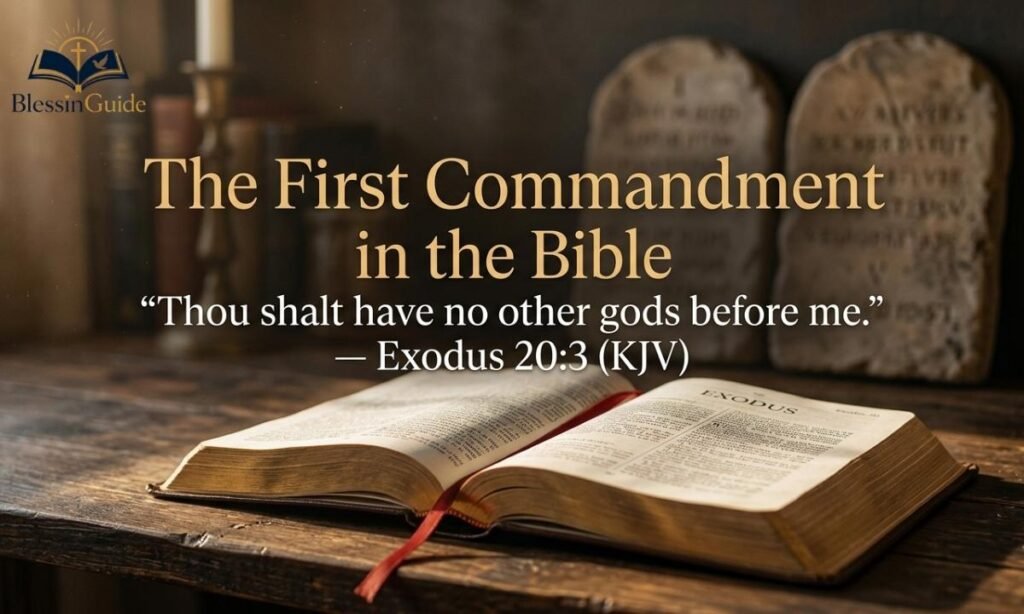
The first commandment appears in the Ten Commandments, which God gave to Israel at Mount Sinai. Most Protestant churches read it as: “You shall have no other gods before me.”
It opens the list because every other command depends on it. If God holds the first place in your heart, honesty, faithfulness, and respect for others follow more naturally.
Quick answer: The first commandment is a call to worship the one true God and nothing else.
Traditions number the commandments differently:
| Tradition | What counts as the first commandment |
| Protestant (most denominations) | “You shall have no other gods before me” |
| Catholic and Lutheran | “I am the Lord your God… you shall have no other gods before me” (includes the ban on idols) |
| Jewish | “I am the Lord your God, who brought you out of Egypt” |
The wording differs slightly, but the core message is the same in all three.
The First Commandment Bible Verse Explained
The verse is found in Exodus 20:3 and repeated in Deuteronomy 5:7. The King James Version reads: “Thou shalt have no other gods before me.”
Here is what each part means:
- “Thou shalt” is a firm command, not a suggestion.
- “No other gods” covers false deities, but also anything treated as divine.
- “Before me” can mean “in front of me” or “in my presence.” Since God is everywhere, nothing is ever outside his sight, so no rival belongs anywhere.
The verse follows a reminder in Exodus 20:2. God says he brought Israel out of slavery in Egypt. So the command rests on relationship and rescue, not only on rules. God first shows who he is, then asks for loyalty.
Why does the First Commandment Come First?
The order is not random. The first four commandments deal with the believer’s relationship with God. The last six deal with relationships between people.
Think of it like a house. The first commandment is the foundation, and the rest are the walls. When the foundation shifts, the whole structure cracks.
Many Bible teachers argue that every sin traces back to a break in this commandment. When someone lies, steals, or cheats, they are trusting something other than God to meet a need. That is why Jesus later linked all the law to one central command, covered below.
What Is the First Commandment in the Old Testament?
In the Old Testament, the first commandment is a covenant demand. Israel lived among nations that worshiped Baal, Asherah, Molech, and Egyptian gods. God told his people to be different.
Key Old Testament passages include:
- Exodus 20:3. The original command at Sinai.
- Deuteronomy 6:4–5. The Shema: “The Lord our God, the Lord is one,” followed by the call to love him with all your heart, soul, and strength.
- Isaiah 45:5. God declares that there is no other God besides him.
- 1 Kings 18. Elijah challenges the prophets of Baal on Mount Carmel and asks Israel how long they will waver between two opinions.
The Old Testament story shows how often Israel struggled with this. Idols were popular, visible, and promised rain, children, and victory. The prophets repeatedly warned that serving other gods led to exile and loss.
What Is the First Commandment in the New Testament?
The New Testament does not erase the first commandment. It deepens it. The wording changes, but the call to exclusive devotion stays.
Examples include:
- Matthew 4:10. Jesus answers Satan: “Worship the Lord your God, and serve him only.”
- Matthew 6:24. “You cannot serve both God and money.”
- 1 Corinthians 10:14. Paul urges believers to flee from idolatry.
- 1 John 5:21. John ends his letter with a short warning: keep yourselves from idols.
In the New Testament, the focus moves from carved statues to the heart. The question becomes not only “Do you bow to an image?” but “What rules are your affections, time, and choices?”
What Does the First Commandment Forbid?
At its simplest, the first commandment forbids giving anyone or anything the worship that belongs to God. That includes more than a statue of a false god.
It forbids:
- Polytheism: believing in or worshiping many gods.
- Idolatry: treating any created thing as ultimate.
- Occult practices: seeking spiritual power or guidance from sources other than God (Deuteronomy 18:10–12).
- Divided loyalty: trying to serve God and a rival at the same time.
- Self-worship: placing your own wants and pride above God’s will.
- Superstition: trusting luck, charms, or fate to protect you.
It also teaches what to do. Love God, trust him, and worship him alone. A commandment against rivals is also an invitation to a faithful relationship.
The First and Second Commandments: Key Differences
People often confuse the first two commandments because both deal with idolatry. The difference is in the focus.
| First Commandment | Second Commandment | |
| Verse | Exodus 20:3 | Exodus 20:4–6 |
| Main concern | Who you worship | How you worship |
| Forbids | Other gods | Making and bowing to carved images |
| Core idea | God alone is God | God must not be reduced to an object |
| Example of breaking it | Treating money as your master | Worshiping a statue as if it holds divine power |
In short, the first commandment protects the object of worship. The second protects the way we worship. One says, “Only the true God.” The other says, “Do not shrink him into something you can carve or control.”
Catholic and Lutheran numbering joins these two into one, which is why their lists look different from Protestant ones. The teaching is the same either way.
What Does “You Shall Have No Other Gods Before Me” Mean?

The phrase means that God must hold first place in your life, with no competitor beside him or above him.
Here is how this plays out:
- Priority. God is not one item on a list of priorities. He is the one who orders the whole list.
- Exclusivity. There is no shared throne. Loving God does not mean ignoring good things, but it does mean ranking them under him.
- Allegiance. When two loyalties collide, such as honesty versus career gain, God’s way wins.
- Trust. You look to him for security, identity, and hope.
A simple illustration: imagine a ship’s captain. Crew members, cargo, and weather all matter. But only one person sets the course. The first commandment says God is that person in your life.
Why Does God Call Himself a Jealous God?
In Exodus 20:5, God says, “I, the Lord your God, am a jealous God.” That sounds strange, because human jealousy is often petty or controlling.
Biblical jealousy is different. It is closer to the protective love of a spouse who is committed to a faithful marriage. God is not insecure. He cares about his people, and he knows that false gods cannot save them.
Consider these points:
- It is a covenant language. The Bible often describes God’s relationship with his people as a marriage (Hosea, Ezekiel 16).
- It is protective. Idols promise much and deliver nothing. God’s jealousy guards his people from harm.
- It is righteous. Unlike human envy, God’s jealousy is not selfish. He alone is worthy of worship, so asking for it is simply truth.
So when God says he is jealous, he is saying that he loves his people too much to share them with things that will ruin them.
What Are Modern Idols? Examples of Idolatry Today
Most people today do not bow before statues. But the Bible’s definition of an idol is broader than a carved image. An idol is anything you rely on or love more than God.
Common modern idols include:
| Modern idol | How it can take God’s place |
| Money and possessions | Security and worth are measured by wealth |
| Career and success | Identity depends on titles, promotions, or achievements |
| Social media and fame | Approval from followers shapes your self-image |
| Relationships | A partner, child, or friend becomes your source of meaning |
| Pleasure and entertainment | Comfort and escape take priority over devotion |
| Power and politics | Hope is placed in leaders or movements |
| Self | Your preferences become the final authority |
| Fitness, appearance, and status | Body and image become the goal of life |
A helpful test is to ask: What do I fear losing most? What do I think about when I am alone? What do I sacrifice time and money for? The honest answers often reveal where your heart sits.
Not all of these things are bad in themselves. Work, family, and rest are gifts. They become idols when they move from gift to god.
How Jesus Explains the First Commandment?
Jesus never weakened the first commandment. He pressed it deeper, from outward behavior to inward loyalty.
When tempted in the wilderness, he quoted Deuteronomy to insist that worship belongs to God alone (Matthew 4:10). In the Sermon on the Mount, he taught that a person cannot serve two masters (Matthew 6:24). He also told a wealthy young man to give up his riches and follow him, because that wealth had become a barrier (Mark 10:21).
Jesus also taught that putting God first does not mean anxious striving. He said, “Seek first his kingdom and his righteousness, and all these things will be given to you” (Matthew 6:33). Priority comes first, and provision follows.
The First Commandment vs. the Greatest Commandment
When asked which commandment was the greatest, Jesus answered: “Love the Lord your God with all your heart and with all your soul and with all your mind” (Matthew 22:37). He then added a second: love your neighbor as yourself.
The two are closely linked, but they are not identical.
| First Commandment | Greatest Commandment | |
| Source | Exodus 20:3 | Deuteronomy 6:5, quoted in Matthew 22:37 |
| Form | A prohibition (“no other gods”) | A positive command (“love God”) |
| Emphasis | What to avoid | What to pursue |
| Relationship | The boundary | The goal |
You could say that the first commandment draws the fence, and the greatest commandment describes the garden inside it. Avoiding idols clears the way for wholehearted love. Wholehearted love leaves no room for idols.
How to Follow the First Commandment in Everyday Life?
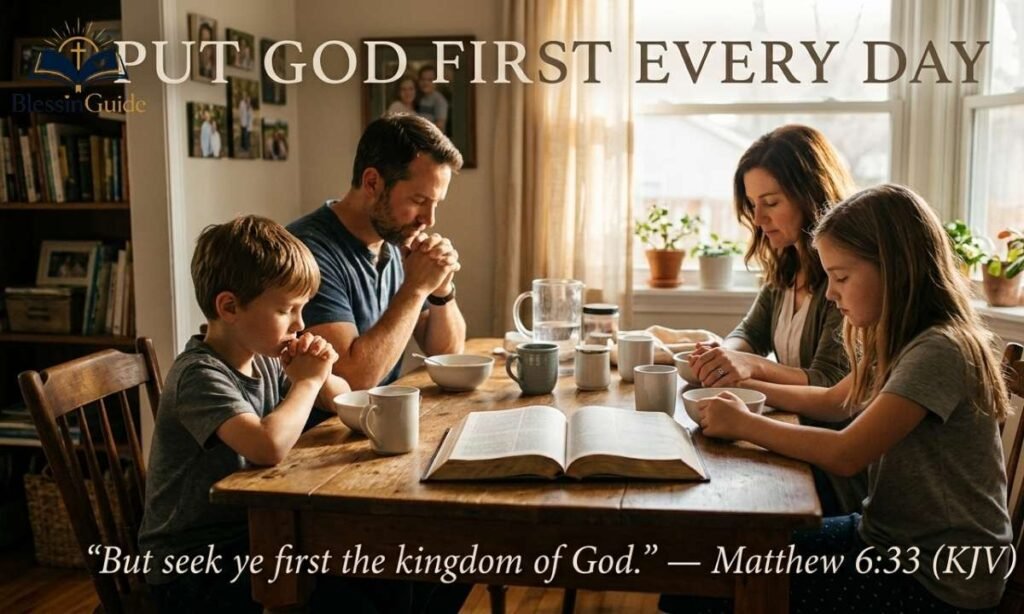
Keeping the first commandment is not about perfection. It is about direction. These habits help:
- Start the day with God. Even five minutes of prayer or Scripture sets your priorities before the world’s noise begins.
- Audit your time and money. Look at your calendar and bank statement. They show what you truly value.
- Name your idols. Ask God to show you what competes for your trust. Write it down.
- Practice gratitude. Thankfulness reminds you that every good thing is a gift, not a god.
- Set limits on screens. Reduce the habits that crowd out prayer, rest, and real relationships.
- Worship with others. Regular church life keeps your loyalty grounded in community.
- Give generously. Giving loosens money’s grip on your heart.
- Confess and return. When you slip, repent quickly and start again. God’s mercy is renewed daily.
Small, steady choices matter more than dramatic gestures.
Bible Verses That Help Explain the First Commandment
These passages are useful for study, memorization, or devotions:
- Exodus 20:2–3. God’s rescue is the basis for his command.
- Deuteronomy 6:4–5. The Shema: one God, one love.
- Joshua 24:15. “Choose for yourselves this day whom you will serve.”
- Psalm 115:3–8. Idols are lifeless; the living God acts.
- Isaiah 44:6. God declares himself the first and the last.
- Jeremiah 2:13. Turning to false sources is like digging broken cisterns.
- Matthew 6:24. No one can serve two masters.
- Matthew 22:37–38. The first and greatest commandment.
- Colossians 3:5. Greed is identified as idolatry.
- 1 John 5:21. Keep yourselves from idols.
A Prayer for Putting God First in Your Life

Lord God, you alone are worthy of my worship. Forgive me for the times I have trusted other things more than you. Show me the idols I cannot see, and give me the courage to put them down.
Teach me to love you with my whole heart, mind, and strength. Help me to seek your kingdom first in my work, my relationships, and my plans. Thank you for your patience and your mercy. In Jesus’ name, amen.
Frequently Asked Questions
What Is the First Commandment in Simple Words?
It says God alone should be worshiped, and nothing should take his place in your life. The verse is Exodus 20:3.
What Does the First Commandment Forbid?
It forbids worshiping false gods and treating anything, such as money, fame, or self, as more important than God.
Is the First Commandment the Same in the Old and New Testaments?
Yes. The Old Testament states it directly, and the New Testament repeats it and applies it to the heart, as in Matthew 4:10 and 1 John 5:21.
What Is the Difference Between the First and Second Commandments?
The first concerns who is worshiped (God alone). The second concerns how God is worshiped (not through carved images).
What Did Jesus Say About the First Commandment?
Jesus said to worship and serve God alone (Matthew 4:10) and called loving God with all your heart the greatest commandment (Matthew 22:37–38).
What Does It Mean to Have No Other Gods Before God?
It means nothing may outrank God in your loyalty, trust, or love. He comes first in every decision.
How Can Christians Follow the First Commandment Today?
By praying daily, identifying modern idols, using time and money wisely, worshiping with a church, and returning to God quickly after failing.
Final Thoughts
The first commandment is short, but it shapes everything else in the Christian life. It asks for undivided love toward the one God who rescues and cares for his people. In both testaments, the message is the same: worship God alone.
Today the temptation is rarely a stone statue. It is more often success, money, approval, or comfort. Keep asking where your heart is placed, and return to God whenever it drifts. He welcomes those who come back to him.
