
Open a concordance and search for Biblical Meaning of 22 , and a pattern starts to emerge almost immediately. It shows up in the very shape of the Hebrew alphabet, in the architecture of the Tabernacle, in the length of a psalm, and in the reigns of two very different kings. That kind of repetition is rarely accidental in Scripture.
This guide walks through every major biblical appearance of the number 22 from Hebrew letters and the Menorah to Psalm 22, Revelation 22, and the number’s spiritual meaning today so you can understand what it means and why it keeps showing up in your own life.
What Does the Number 22 Mean in the Bible? Key Facts at a Glance
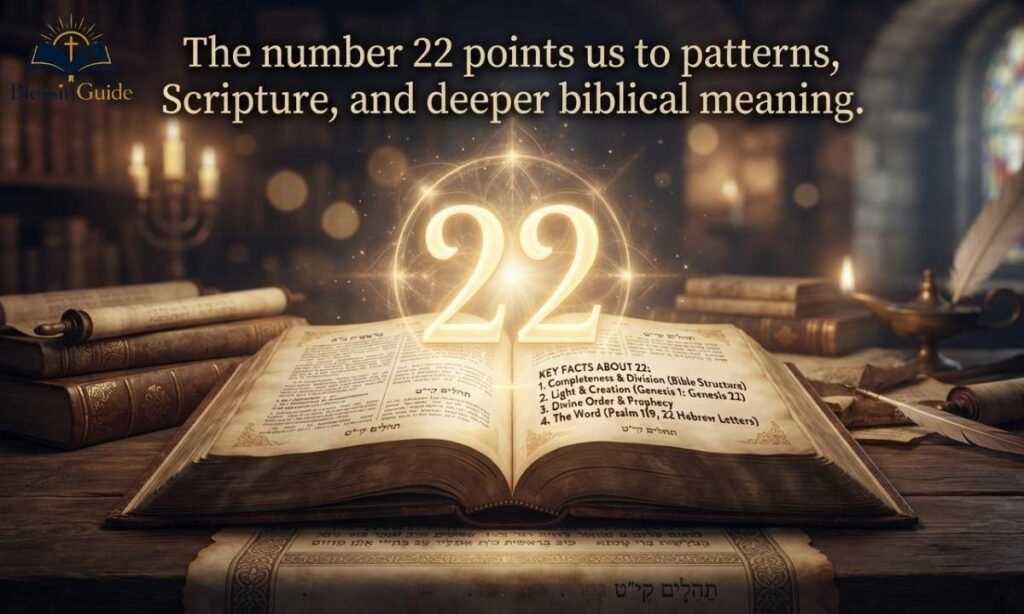
Before diving into the details, here is a quick-reference summary of the number 22’s most important biblical appearances and what they’re commonly understood to represent.
| Biblical Appearance | Reference | Common Interpretation |
| Letters in the Hebrew alphabet | Aleph to Tav | Completeness of God’s spoken word |
| Almond blossoms on the Menorah | Exodus 25:31-34 | Divine light and revelation |
| Sections of Psalm 119 | Psalm 119:1-176 | Order, devotion, and God’s law |
| Years Jair judged Israel | Judges 10:3 | Steady, righteous leadership |
| Years Jeroboam I reigned | 1 Kings 14:20 | Disorder tied to idolatry |
| Chapters in the Book of Revelation | Revelation 1-22 | Prophetic completion |
| Chapters in 1 Kings | 1 Kings 1-22 | The unfolding of a divided kingdom |
As the table shows, 22 isn’t tied to a single fixed meaning. Its significance shifts depending on context, sometimes pointing to divine order and revelation, other times marking seasons of chaos or judgment.
What Is the Biblical Significance of the Number 22?
Numbers in Scripture rarely function as mere counting devices. Writers of the Old and New Testaments frequently used numerical patterns to reinforce a theological point, and 22 is one of the more structurally significant examples in the entire Bible.
At its core, the number 22 is tied to two closely related ideas: completeness of communication and structural order. Because the Hebrew alphabet, the alphabet God’s Word was first written in, contains exactly 22 letters, many Bible scholars and Hebrew-language teachers treat 22 as a symbol of the full, finished expression of divine speech.
At the same time, 22 shows up in some of the Bible’s darker moments, including the reigns of troubled kings. This dual nature is part of what makes the number so interesting to study: it can represent both the fullness of God’s revealed Word and the consequences of turning away from it.
The Hebrew Meaning of 22 in the Bible
To understand why 22 carries so much theological weight, it helps to look at the Bible’s original language. Hebrew is where the number’s structural meaning is most visible.
The 22 Letters of the Hebrew Alphabet
The Hebrew alphabet consists of exactly 22 consonantal letters, running from Aleph (א) to Tav (ת). Ancient rabbinic tradition held that these letters were not simply a writing system but the actual building blocks God used to speak the universe into existence. Every word in the Hebrew Old Testament, from Genesis to Malachi, is constructed from some combination of these 22 characters.
Because of this, Jewish scholars have long associated the number 22 with the totality of creation through speech the idea that God’s Word, properly assembled, is complete and lacks nothing.
The Aleph-Tav Connection
Aleph is the first letter of the Hebrew alphabet; Tav is the last. Together, “Aleph to Tav” functions in Hebrew the same way “Alpha and Omega” functions in Greek as a merism meaning “the first and the last” or “the whole of it.” Revelation 22:13 echoes this exact concept when the risen Christ declares, “I am Alpha and Omega, the beginning and the end, the first and the last.”
Interestingly, the Hebrew direct object marker אֵת (et), made up of Aleph and Tav, appears at the start of Genesis 1:1, right before the word “heavens.” Many Hebrew-Roots teachers have pointed to this as a subtle picture of the totality of God’s Word being present at creation bookended, quite literally, by the first and last letters of the alphabet.
Psalm 119 and Its 22-Part Structure
Psalm 119, the longest chapter in the Bible, is built as an acrostic poem with exactly 22 stanzas one for each letter of the Hebrew alphabet, in order. Every verse within a given stanza begins with that stanza’s assigned letter. The result is a 176-verse meditation on God’s law, word, statutes, and commandments that is structured, quite deliberately, around the full alphabet.
This structure reinforces the same idea found elsewhere in Scripture: 22 represents a complete, ordered expression in this case, a complete expression of devotion to God’s Word from A to Z, or in Hebrew terms, from Aleph to Tav.
The Menorah and the 22 Almond Blossoms
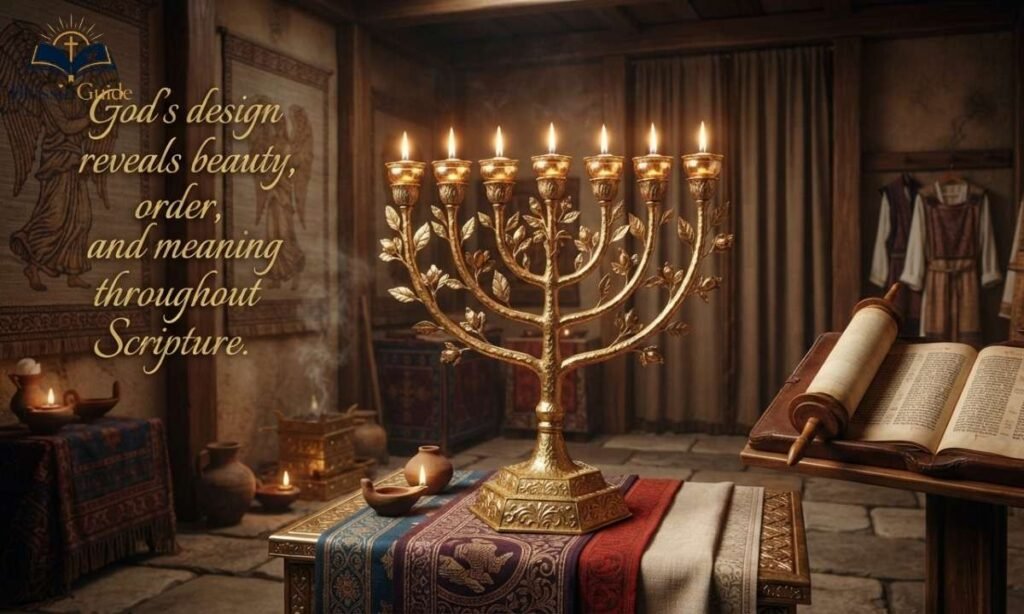
Exodus 25:31-34 gives detailed instructions for the golden Menorah that stood in the Tabernacle. The lampstand’s central shaft and six branches were decorated with cups shaped like almond blossoms, complete with buds and flowers. When the design is counted carefully across the central shaft and all six branches, the total comes to 22 almond-blossom cups.
The almond tree held special symbolism in Israelite culture it was the first tree to bloom each spring, making it a natural picture of watchfulness, new life, and God acting swiftly on His word (see the wordplay between “almond” and “watching” in Jeremiah 1:11-12). Since the Menorah itself represented divine light in the Tabernacle, its 22 almond blossoms tie the number 22 directly to the themes of illumination, revelation, and God’s attentive presence among His people.
What Does the Number 22 Represent Spiritually?
Spiritually, most Bible teachers connect the number 22 to three overlapping themes:
- Revelation and light tied to the Menorah’s almond blossoms and the idea of God’s Word illuminating the path ahead.
- Completeness and order tied to the 22 letters of the Hebrew alphabet and the 22-part structure of Psalm 119.
- Warning and reordering tied to the reigns of kings like Jeroboam, where 22 marks a season that ultimately needed correction.
Outside of formal Bible study, many people today report seeing the number 22 repeatedly on clocks, receipts, license plates, or addresses and wonder if it carries spiritual meaning. In a biblical framework, this kind of pattern is best treated as a prompt for reflection rather than a coded message. If 22 keeps catching your attention, Scripture would encourage you to respond not with superstition, but with renewed attention to God’s Word, the very thing the number so consistently symbolizes.
Number 22 Biblical Meaning According to Strong’s Concordance
Strong’s Concordance doesn’t assign meanings to numbers directly; it’s an index of the original Hebrew and Greek words behind the King James Version, each tagged with a reference number. Strong’s number 22 itself happens to correspond to a real word, though, and it’s a fitting one.
Strong’s Hebrew #22 is אֲבִיאֵל (Abiel), a proper name built from two roots: אָב (av, “father”) and אֵל (El, “God”). The name literally means “father of God” or, more naturally rendered, “possessor of God” Abiel appears in 1 Samuel 9:1 as the grandfather of King Saul. While this is a genealogical detail rather than a numerological one, some Bible-numerics writers note the poetic overlap: a Strong’s entry meaning “possessor of God” sitting at the number most associated with the completeness of God’s revealed Word.
It’s worth being cautious here. Strong’s numbering is alphabetical by appearance in the KJV word list, not a divine cipher, so this connection is an interesting observation rather than a doctrinal claim.
The Prophetic Meaning of 22: From Psalm 22 to Revelation 22
Two of the Bible’s most quoted chapters share the number 22, and together they form a striking arc from suffering to glory from the cross to the New Jerusalem.
Psalm 22 and the Suffering Servant
Psalm 22 opens with the words, “My God, my God, why have you forsaken me?” the same cry Jesus spoke from the cross (Matthew 27:46). The psalm goes on to describe pierced hands and feet, divided garments, and mockery from onlookers, details that align remarkably with the Gospel crucifixion accounts written centuries later. For this reason, Psalm 22 is widely read as a messianic psalm: a prophetic preview of the Messiah’s suffering, written in the voice of David but pointing far beyond him.
Revelation 22 and the Glorified King
Revelation 22 closes the entire Bible with a picture of New Jerusalem, the river of life, the tree of life bearing fruit every month, and God’s throne at the center of it all. Where Psalm 22 shows a suffering, forsaken figure, Revelation 22 shows the same figure reigning in glory, described as “the root and descendant of David, the bright morning star” (Revelation 22:16). Read side by side, Psalm 22 and Revelation 22 trace the full arc of the gospel story: humiliation followed by exaltation.
The Meaning of 22:22 in the Bible
Not every book of the Bible has a chapter 22 with a verse 22, so “22:22” doesn’t point to one single, universal passage the way some repeating numbers do. Instead, it shows up multiple times across different books, and its meaning depends entirely on context:
- Genesis 22:22 lists descendants of Abraham’s brother Nahor in a quiet genealogical note.
- Numbers 22:22 describes God’s anger being kindled against Balaam as he set out to curse Israel, right before the famous encounter with his donkey.
- Proverbs 22:22 warns against exploiting the poor: “Do not rob the poor, because he is poor.”
- Jeremiah 22:22 pictures leaders being carried away by the wind because of their wickedness.
People who notice “22:22” on a clock or elsewhere often ask what it means spiritually. Biblically, the honest answer is that there is no single fixed message attached to that exact digit pairing; the responsible approach is to treat it as a nudge to open Scripture and read, rather than to assume a specific verse is being pointed to.
What Does 22 Mean in Different Biblical Contexts?
The table below summarizes how the number 22’s meaning shifts depending on where it appears in Scripture.
| Context | Example | Theme |
| Language and structure | 22 letters of the Hebrew alphabet | Completeness of communication |
| Worship and Tabernacle | 22 almond blossoms on the Menorah | Light and revelation |
| Poetry and devotion | 22 stanzas of Psalm 119 | Ordered devotion to God’s Word |
| Righteous leadership | 22 years Jair judged Israel | Stability under godly guidance |
| Compromised leadership | 22 years Jeroboam I reigned | Disorder that follows idolatry |
| Prophecy | Revelation’s 22 chapters | The completed unveiling of God’s plan |
Number 22 vs Other Biblical Numbers: A Quick Comparison
Seeing how 22 relates to other well-known biblical numbers helps put its meaning in perspective. Numbers like 7, 12, and 40 are more frequently discussed, but 22 fills a distinct structural role of its own.
| Number | Core Biblical Meaning | Well-Known Example |
| 7 | Completion, rest, perfection | Seven days of creation (Genesis 2:2-3) |
| 12 | Divine government, God’s people | Twelve tribes of Israel, twelve apostles |
| 22 | Fullness of God’s spoken Word, structure | 22 letters of the Hebrew alphabet |
| 40 | Testing, trial, transition | 40 years in the wilderness |
Where 7 speaks to rest and 40 speaks to testing, 22 speaks specifically to structure and completeness of expression. It’s less about a period of time and more about the full shape of a thing, whether that’s an alphabet, a psalm, or a book of prophecy.
The Tale of Two Kings: Order and Chaos
Two figures in the Old Testament reigned or judged for exactly 22 years, and their stories couldn’t be more different. Placed side by side, they show how the same number can frame two opposite outcomes depending on the choices of the person involved.
Jair and the Theme of Righteous Judgment
Judges 10:3-5 records that Jair the Gileadite judged Israel for 22 years. Unlike many of the judges before him, Jair’s account contains no record of battle, oppression, or national sin. He is remembered instead for a peaceful, stable household of 30 sons, 30 donkeys, and 30 towns known as Havvoth-Jair. His 22-year period reads as a season of quiet order, a picture of what steady, faithful leadership looks like.
Jeroboam and the Theme of Idolatry
1 Kings 14:20 records that Jeroboam I, the first king of the northern kingdom of Israel after the nation split, reigned for 22 years. Unlike Jair, Jeroboam’s legacy is defined almost entirely by failure: he set up golden calves at Bethel and Dan so the people wouldn’t return to worship in Jerusalem, a decision the Bible repeatedly condemns as “the sin of Jeroboam” (see 1 Kings 15:34, 16:19, 16:26). His 22-year reign became shorthand throughout the rest of 1 and 2 Kings for idolatry and its consequences.
Together, Jair and Jeroboam show that 22 isn’t a guarantee of blessing or judgment on its own; it’s the choices made within that span of time that determine whether the number marks order or chaos.
Common Misconceptions About the Number 22 in the Bible
A few claims about the number 22 circulate widely online but don’t hold up well against the biblical text:
- “22 always means chaos.” This idea usually comes from treating 22 as “double 11,” a number sometimes associated with disorder in popular numerology. Scripture itself never states this directly 22 appears in orderly contexts (Psalm 119, the Menorah) just as often as chaotic ones.
- “Seeing 22 is a direct message from God.” The Bible doesn’t teach that individual numbers function as personal messages outside of their scriptural context. A better response to noticing 22 repeatedly is to turn to Scripture, not to treat the number itself as a communication channel.
- “22 is one of the Bible’s ‘master numbers.'” This label comes from modern numerology systems, not from biblical theology. Scripture’s numeric patterns are meaningful, but they function as literary and structural devices, not as a numerology system in the New Age sense.
Biblical Meaning of 22 in Your Life and Spiritual Journey
If the number 22 has been showing up repeatedly in your life, Scripture’s pattern gives a grounded way to respond. Rather than searching for a hidden personal prophecy, consider what the number consistently points back to throughout the Bible: the completeness and sufficiency of God’s Word.
That can translate into a few practical steps:
- Treat repeated sightings of 22 as a gentle nudge to spend time in Scripture, much like Psalm 119’s writer devoted an entire acrostic to God’s law.
- Ask whether an area of your life currently reflects Jair’s steady order or Jeroboam’s compromise, and let that self-check guide a change of direction if needed.
- Hold the number loosely. The Bible never instructs believers to build personal guidance systems around recurring digits; its focus stays on the written Word itself.
How Should Christians Interpret Seeing the Number 22?
Bible-believing interpreters generally caution against reading too much into any single recurring number, including 22. The safest approach is to let Scripture’s own use of 22 the Hebrew alphabet, the Menorah, Psalm 119, Psalm 22, and Revelation 22 inform how you think about the number, rather than looking for a private, personalized meaning outside of the text.
In practice, that means using the appearance of 22 as an invitation rather than an oracle: an invitation to open the Word, to examine whether your life currently mirrors order or disorder, and to remember that Scripture presents itself, from Aleph to Tav, as complete and sufficient for guidance.
Frequently Asked Questions
What does the number 22 mean in the Bible?
It’s most closely tied to completeness and divine revelation, largely because the Hebrew alphabet has 22 letters and the Menorah has 22 almond blossoms.
What does the number 22 represent spiritually?
Spiritually, 22 represents light, order, and the fullness of God’s Word, while also serving as a reminder to examine whether your life reflects order or compromise.
Is the number 22 significant in the Bible?
Yes it appears in the Hebrew alphabet, the Menorah’s design, Psalm 119’s structure, two kings’ reigns, and the chapter counts of 1 Kings and Revelation.
What does 22:22 mean in the Bible?
There’s no single fixed meaning; 22:22 appears in several books with different messages, from genealogy in Genesis to a warning in Jeremiah.
What does seeing the number 22 mean spiritually?
Many take it as a prompt to return to Scripture and reflect on personal order versus disorder, rather than as a coded personal message.
Final Thoughts
The number 22 threads through the Bible in ways that are easy to miss on a single read-through but become striking once you start connecting them: an alphabet, a lampstand, a psalm, two kings, and the final book of Scripture all share this number, and each appearance adds another layer to its meaning.
Whatever led you to look this up a passing curiosity or a number you keep noticing the biblical pattern points in one consistent direction: back to the completeness of God’s Word. That’s a fitting note to end on, since Scripture itself, from Aleph to Tav, claims to be exactly that.
