

Samuel stands as one of the most respected figures in the Old Testament, the last judge of Israel, a lifelong prophet, and the man who anointed both King Saul and King David. Yet many readers reach the short verse describing his death and are left with more questions than answers, since Scripture records the fact of his passing without giving graphic detail.
This article walks through exactly what the Bible says about Samuel’s death, where he was buried, how old he may have been, and why his passing still matters to readers today. Along the way, we’ll look at the surrounding events in 1 Samuel, compare timelines with David’s rise to kingship, and answer the most common questions people search for on this topic.
How Did Samuel Die in the Bible?
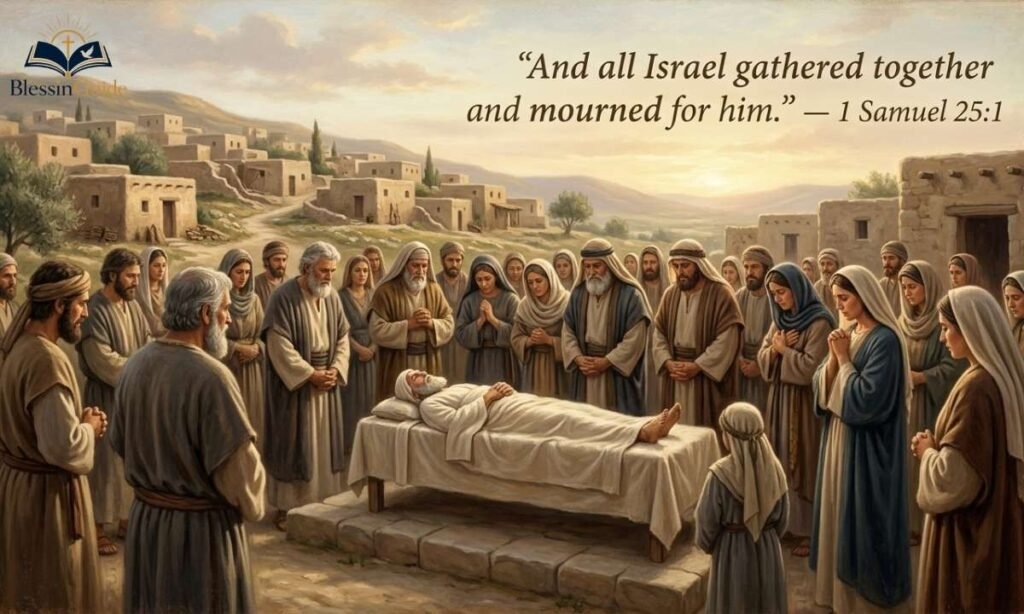
The Bible does not describe Samuel dying from violence, illness, or any dramatic incident. Scripture simply states that he died of natural causes after a long life of service, and that all of Israel mourned him.
The key verse is found in 1 Samuel 25:1:
“Now Samuel died, and all Israel gathered together and mourned him, and buried him at his home in Ramah.”
This single sentence is the primary and essentially only account of Samuel’s death in the Old Testament. The same event is referenced again later in 1 Samuel 28:3, when Saul seeks out the medium at En-dor, reminding readers that “Samuel was dead, and all Israel had mourned for him and buried him in Ramah, his own city.”
What Does the Bible Say About Samuel’s Death?
The biblical text is intentionally brief. It tells us three things: Samuel died, the nation mourned him collectively, and he was buried in his hometown of Ramah. There is no mention of a specific illness, injury, or cause.
This brevity is actually consistent with how the Bible treats many of its major figures. Death is often recorded as a simple fact, with the focus placed on legacy rather than the circumstances of dying. For Samuel, a man who had served as judge, priest, and prophet for decades, the emphasis rests on the nation’s collective grief rather than the manner of his death.
Does the Bible Explain How Samuel Died?
No, the Bible does not explain a specific cause of death for Samuel. Scholars and Bible commentators generally agree that his death was simply due to old age, since he had already been described as elderly in earlier chapters of 1 Samuel.
Because Samuel had been a prominent leader since childhood serving under Eli the priest at Shiloh by the time of his death he had likely lived a very long life. There is no textual evidence suggesting foul play, illness, or any unusual circumstance surrounding his passing.
What Happened Before Samuel Died?
To understand Samuel’s death in context, it helps to look at what was happening in Israel during his final years. By this point in the biblical narrative, Saul had already been rejected by God as king, and David had already been secretly anointed as Saul’s successor.
Samuel’s Final Years as a Prophet
In his later years, Samuel largely stepped back from public governance after Saul’s coronation, though he remained active as a prophet and spiritual authority. He delivered several pointed warnings to Saul, including the famous rebuke after Saul’s disobedience regarding the Amalekites in 1 Samuel 15.
Some key events from Samuel’s final chapter of life include:
- Rebuking Saul for offering an unauthorized sacrifice (1 Samuel 13)
- Confronting Saul over his failure to fully destroy the Amalekites (1 Samuel 15)
- Secretly anointing David as the future king in Bethlehem (1 Samuel 16)
- Sheltering David briefly at Naioth in Ramah when Saul pursued him (1 Samuel 19)
Samuel’s Role in Israel Before His Death
Even after Israel transitioned from a system of judges to a monarchy, Samuel remained the nation’s moral and spiritual compass. He was the one who anointed kings, but he never held royal power himself. His authority came from his lifelong relationship with God, not from a throne.
By the time of his death, Samuel had:
| Role | Description |
| Judge | Led Israel for decades, delivering justice and spiritual guidance |
| Prophet | Received and delivered God’s messages, including warnings to Saul |
| Priest-like figure | Offered sacrifices and led national worship at Mizpah and other sites |
| Kingmaker | Anointed both Saul and David as kings of Israel |
His death marked the end of an era, the last living link to the period of the judges, and one of the final voices of direct prophetic authority before Israel’s monarchy fully took shape under Saul and later David.
How Old Was Samuel When He Died?
Does the Bible Reveal Samuel’s Age?
No, the Bible never states Samuel’s exact age at the time of his death. Unlike some other biblical figures, such as Abraham (175 years) or Moses (120 years), Samuel’s lifespan is not recorded with a specific number.
What Can We Know About Samuel’s Age?
While an exact figure isn’t given, we can estimate Samuel’s age using the timeline of his life. He began serving at the tabernacle in Shiloh as a young child, likely around age three, and continued in ministry through the reigns of Saul as king, a period most scholars place at around 40 years.
Based on this, many Bible scholars and historians estimate Samuel lived to be somewhere between 70 and 100 years old, though this remains an educated estimate rather than a scriptural fact. What is clear from the text is that he was already described as “old” (1 Samuel 8:1) years before his death, indicating a long life of service.
Did Samuel Die Before David Became King?
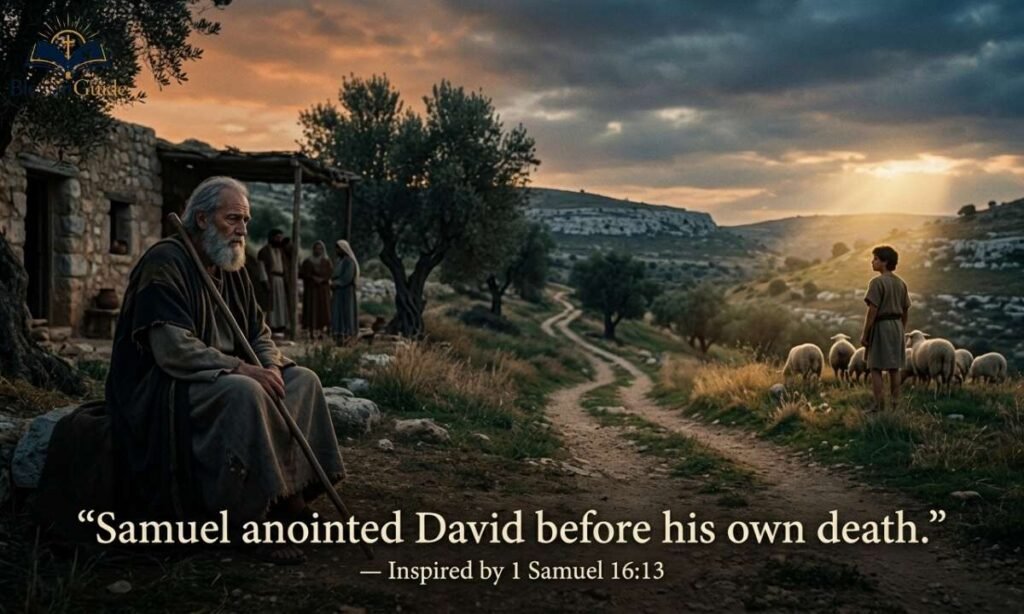
Yes. Samuel died while Saul was still reigning as king of Israel, years before David officially became king after Saul’s death.
Samuel and David’s Timeline
Understanding the order of events helps clarify this. Here is a simplified timeline of how Samuel’s death fits into the larger narrative of 1 and 2 Samuel:
| Event | Bible Reference |
| Samuel anoints Saul as king | 1 Samuel 10 |
| Samuel anoints David as future king | 1 Samuel 16 |
| Saul pursues David; Samuel shelters David | 1 Samuel 19 |
| Samuel dies and is buried in Ramah | 1 Samuel 25:1 |
| David spares Saul’s life (Cave of En-gedi) | 1 Samuel 24 |
| Saul consults the medium of En-dor | 1 Samuel 28 |
| Saul dies at Mount Gilboa | 1 Samuel 31 |
| David becomes king over Judah, then all Israel | 2 Samuel 2 & 5 |
Was David King When Samuel Died?
No, David was not yet king when Samuel died. At the time of Samuel’s death, David was still a fugitive, fleeing from Saul’s attempts on his life. David would not become king until years later, first over the tribe of Judah and eventually over the unified kingdom of Israel, following Saul’s death in battle.
This means Samuel never lived to see David officially crowned, even though it was Samuel himself who had anointed David as God’s chosen future king back in Bethlehem.
Where Was Samuel Buried?
Samuel’s Burial at Ramah
Samuel was buried at his home in Ramah, the same town where he was born and where he had lived for much of his life. Ramah (sometimes called Ramathaim) was Samuel’s family home and also served as a center of his prophetic activity, including a place called Naioth where a group of prophets gathered under his leadership.
The location holds particular significance because Ramah wasn’t just any city; it was deeply tied to Samuel’s personal story, from his mother Hannah’s prayers for a son to his final resting place decades later.
How Did Israel Mourn Samuel?
According to 1 Samuel 25:1, “all Israel” gathered together to lament him. This phrase indicates a nationwide outpouring of grief, not a small or private funeral. Such widespread mourning reflects just how central Samuel’s role had been to the spiritual and political life of the nation.
A few points worth noting about this mourning:
- It was described as a collective, national event not limited to his hometown
- The Hebrew term used for “lamented” suggests formal, ritual mourning practices common in ancient Israel
- His burial “in his house” likely refers to burial on his family property, a common practice for prominent individuals in that era
Did David Attend Samuel’s Funeral?
The Bible does not explicitly say whether David personally attended Samuel’s funeral. Scripture moves directly from the statement of Samuel’s death and burial to David’s next actions in the wilderness of Paran, without confirming his presence at the event.
What Happened to David After Samuel Died?
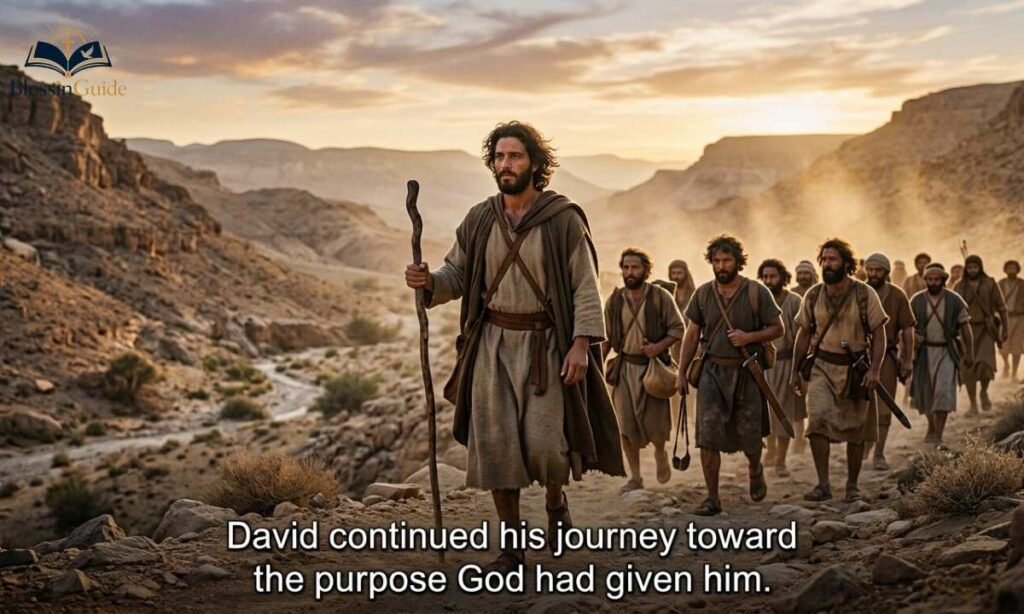
Immediately after recording Samuel’s death, 1 Samuel 25:1 states that David moved down into the Wilderness of Paran. This is also the chapter where David’s interactions with Nabal and Abigail take place, a pivotal story that immediately follows the note of Samuel’s death.
Given that David was actively hiding from Saul at this time, it’s considered unlikely though not impossible that he risked a public appearance to attend the funeral in Ramah. What is certain is that Samuel’s death marked a turning point in the narrative, removing one of David’s few remaining protectors and pushing the story further toward the eventual showdown between David and Saul’s legacy.
What Does Samuel’s Death Teach Us?
Samuel’s Legacy as a Prophet
Samuel’s life demonstrates unwavering faithfulness across multiple roles and several decades of service. He transitioned Israel from the chaotic period of the judges into the era of kings, all while remaining personally humble and refusing to seek power for himself or his family.
His legacy includes:
- Establishing a model of prophetic accountability, where even kings were answerable to God’s word
- Anointing two very different kings, showing discernment guided by God rather than popular opinion
- Leaving behind a pattern of integrity, famously affirmed by his own testimony in 1 Samuel 12 that he had not taken bribes or wronged the people he led
Samuel’s Importance in the Story of Israel
Samuel’s death did not end his influence. His name and example continued to shape Israel’s understanding of leadership, obedience, and faithfulness long after he was gone. Even in death, he reappears symbolically in 1 Samuel 28, when Saul, desperate and abandoned by God, seeks a final word from him through the medium at En-dor.
That episode alone underscores how significant Samuel remained in the national consciousness: even a disgraced king facing his final battle sought out the memory and authority of a prophet who had already been buried for some time.
How Does Samuel’s Death Compare to Other Biblical Leaders?
It’s worth pausing to compare how the Bible records Samuel’s death against other major Old Testament figures. This comparison helps readers understand why Samuel’s passing feels so understated compared to some of his contemporaries.
| Figure | Recorded Age | Cause of Death | Burial Location |
| Samuel | Not stated | Not stated (presumed natural/old age) | Ramah |
| Moses | 120 years | Natural death on Mount Nebo | Unknown, in Moab |
| Aaron | 123 years | Natural death | Mount Hor |
| Joshua | 110 years | Natural death | Timnath-serah |
| Saul | Not stated | Died by his own sword after battle wounds | Jabesh-gilead, later Zelah |
| Eli | 98 years | Fell backward and broke his neck upon hearing news of the Ark’s capture | Not specified |
This table highlights an important pattern: while many leaders in the Old Testament have their age and cause of death clearly recorded, Samuel’s account stands out for its simplicity. Unlike Eli’s sudden and dramatic death, or Saul’s violent end in battle, Samuel’s passing reads as calm, expected, and dignified, consistent with a life that ended in peace rather than crisis.
This contrast also reinforces a broader theme in the books of Samuel: while kings like Saul meet turbulent, often tragic ends, the prophet who anointed them departs quietly, with the entire nation pausing to grieve rather than react to scandal or war.
Key Lessons From Samuel’s Life and Death
Beyond the historical and textual details, Samuel’s story offers several practical lessons that continue to resonate with readers today, regardless of their familiarity with the wider narrative of 1 Samuel.
- Faithfulness over a lifetime matters more than a dramatic ending. Samuel wasn’t remembered for how he died, but for how consistently he served across decades as a child at Shiloh, a judge in his prime, and an elder advisor in his final years.
- Integrity leaves a legacy that outlasts a person’s life. Samuel’s own words in 1 Samuel 12, where he publicly affirmed he had never taken bribes or exploited his position, is echoed in how the nation mourned him: with genuine, widespread grief rather than relief.
- Spiritual influence doesn’t require political power. Samuel never sought to be king, yet his influence on Israel’s monarchy through Saul and David shaped the nation’s future far more than any single ruler.
- Mentorship has a lasting impact. Samuel guided both Saul and David at pivotal moments, and even after his death, his memory continued to carry weight, as seen when Saul sought him out through the medium at En-dor.
- A quiet death doesn’t diminish a significant life. The brevity of 1 Samuel 25:1 can feel anticlimactic, but it reflects a life so well-established that an elaborate account of his final moments simply wasn’t necessary to convey his importance.
These themes are part of why Samuel remains a frequently studied figure in sermons, Bible studies, and devotional writing, even though the biblical text devotes relatively few verses to the actual event of his death.
Frequently Asked Questions
How Did Samuel Die in the Bible?
The Bible does not give a specific cause of death for Samuel. It simply states in 1 Samuel 25:1 that he died, likely of old age, after decades of service as Israel’s prophet and judge.
How Old Was Samuel When He Died?
Samuel’s exact age is not recorded in Scripture. Based on the length of his ministry, scholars estimate he was likely between 70 and 100 years old at the time of his death.
Where Was Samuel Buried in the Bible?
Samuel was buried at his home in Ramah, the town where he was born, raised, and had served as Israel’s spiritual leader for most of his life.
Did Samuel Die Before David Became King?
Yes, Samuel died while Saul was still king, years before David was crowned king of Judah and later all of Israel.
What Does Samuel’s Death Mean in the Bible?
Samuel’s death marks the end of an era of direct judge-led leadership in Israel and highlights his lasting legacy as a faithful, incorruptible prophet whose influence continued even after he was gone.
Final Thoughts
Samuel’s death, though recorded in just a few verses, carries real weight in the broader story of Israel. He died peacefully in old age, was mourned by the entire nation, and was buried in the town of Ramah that had shaped his entire life from his mother Hannah’s prayers to his final years advising and rebuking Israel’s first king.
While the Bible leaves out details like his exact age or cause of death, what it does tell us is enough to understand his significance: a faithful prophet, judge, and kingmaker whose legacy outlived him. His story serves as a reminder that a life of consistent faithfulness leaves an impact that no single verse about death can fully capture.
